Do You Need Hard Wired Smoke Alarms?

If you are installing new smoke alarms or replacing an existing fire alarm system, you may be wondering: do you need hard wired smoke alarms in the UK? If you want to buy a smoke alarm but aren’t sure what price range to choose, you can refer to “How Much Are Smoke Alarms.”
The answer depends on where you live, whether you own or rent your home, and whether the property is newly built or undergoing building work. In some situations, mains-powered smoke alarms are required or expected under the applicable building regulations. In others, sealed long-life battery alarms can be a suitable alternative.
It is also important to understand the difference between hard-wired smoke alarms and interlinked smoke alarms. One describes how an alarm receives power, while the other describes how multiple alarms communicate.
In this guide, we explain UK smoke alarm requirements, compare hard-wired and battery-powered systems, and help you choose the right solution for your property.
What Are Hard-Wired Smoke Alarms?
Hard-wired smoke alarms, also known as mains-powered smoke alarms, are connected to a property’s fixed electrical supply. Many models also have a backup battery or another standby power source to help maintain protection during a power cut.
Unlike a basic battery-powered smoke alarm, a hard-wired alarm relies on the property’s electrical installation for its main power supply.
There are two important features to understand:
- Power supply: A hard-wired smoke alarm receives its main power from the electrical supply, while a battery-powered model operates from its battery.
- Interlinking: Interlinked smoke alarms communicate with one another so that when one alarm detects a potential fire, the other compatible alarms also sound.
These features are separate. Some hard-wired smoke alarms communicate through wiring, while others use radio communication to connect with compatible alarms.
This means a system can have mains-powered alarms that are wirelessly interlinked. You do not necessarily need interconnecting cables between every alarm just because the system is mains-powered.
Do You Need Hard Wired Smoke Alarms in the UK?
There is no single rule requiring every existing home across the UK to have hard-wired smoke alarms. The requirements differ between England, Wales, Scotland and Northern Ireland, and additional rules may apply to particular buildings or tenancies.
1. England: Are Hard-Wired Smoke Alarms Required by Law?
For existing owner-occupied homes in England, there is no general rule that every smoke alarm must be hard-wired simply because it is installed in a home.
However, building regulations are relevant when a property is newly built or certain building work is carried out. Government guidance for new dwellinghouses refers to smoke alarm systems designed in accordance with BS 5839-6, including a Grade D2 Category LD3 system as a minimum approach under the guidance. This is a mains-powered arrangement with standby power.
If you are building a new home, converting a property or carrying out a significant renovation, check the applicable building regulations and obtain advice from building control or a suitably qualified professional.
What about rented properties in England?
Under the Smoke and Carbon Monoxide Alarm (England) Regulations, relevant landlords must provide at least one smoke alarm on each storey containing a room used wholly or partly as living accommodation. Landlords must also ensure prescribed alarms are working at the start of a new tenancy and repair or replace faulty alarms when the relevant requirements are met.
These regulations do not specify that every required smoke alarm must be mains-powered. The correct choice depends on the property, its circumstances and any other applicable requirements.
Read the official GOV.UK guidance for landlords and tenants.
2. Wales: Do Rental Properties Need Hard-Wired Smoke Alarms?
Wales has a specific requirement for rented homes.
Under the Renting Homes (Fitness for Human Habitation) (Wales) Regulations 2022, landlords must ensure that each storey of a dwelling has a working smoke alarm connected to the property’s electrical supply. Each such alarm must also be linked to every other smoke alarm in the dwelling that is connected to the electrical supply.
In practical terms, at least one mains-powered, interlinked smoke alarm is required on each storey of a relevant rented property in Wales.
Additional alarms may be battery-powered, provided the applicable requirements are met. However, the overall system must be designed with the property’s layout and legal obligations in mind.
If you are a landlord in Wales, do not assume that a battery-only system will meet the minimum requirement for every storey. Check the current rules before buying replacement alarms.
For the official explanation, see the Welsh Government’s guidance for landlords.
3. Scotland: Do All Homes Need Hard-Wired Smoke Alarms?
Scotland has a specific fire and smoke alarm standard that applies to all homes. However, this does not mean that every home must have hard-wired alarms.
The Scottish Government states that every home must have:
- A smoke alarm in the living room or the room used most during the day.
- A smoke alarm in every hallway and landing.
- A heat alarm in the kitchen.
The required smoke and heat alarms must be ceiling-mounted and interlinked.
Both mains-wired alarms and sealed, tamper-proof alarms with long-life batteries can meet the standard. Radio-interlinked alarms are also available, so the alarms do not necessarily need to be connected to one another by cables or use Wi-Fi.
This gives homeowners a choice between mains-powered systems and suitable sealed-battery alternatives, provided the complete installation meets the Scottish requirements.
If you are upgrading a home in Scotland, focus on the required alarm locations, interlinking and appropriate power supply rather than assuming hard-wiring is compulsory.
Read the Scottish Government’s fire and smoke alarm guidance.
4. Northern Ireland: What Are the Requirements?
Northern Ireland introduced updated smoke, heat and carbon monoxide alarm requirements for private rented properties in 2024.
Landlords must provide smoke alarms in the main daytime living room and circulation spaces on each storey, as well as a heat alarm in every kitchen. Carbon monoxide alarms are also required in specified rooms or circulation spaces containing relevant combustion appliances or flues.
The regulations allow hard-wired alarms, sealed long-life battery alarms, or a combination of both. Smoke and heat alarms must be interlinked.
Where alarms were installed to meet Building Control requirements, landlords must not simply disable or replace them with a different type without checking the applicable requirements.
For the full details, consult the Northern Ireland Department for Communities guidance.
Hard-Wired vs Battery-Powered Smoke Alarms: Which Is Better?
Both types can provide an important early warning of fire when correctly selected, installed, maintained and tested. The right choice depends on your property’s requirements and the installation involved.
Advantages of Hard-Wired Smoke Alarms
1. A mains power supply
Hard-wired smoke alarms receive their main power from the property’s electrical supply. Models with a suitable standby power source can continue to operate during a mains power interruption, subject to the manufacturer’s specifications.
2. Suitable for certain building projects
Mains-powered systems are relevant to many new-build and building-regulation applications. They may also be appropriate when upgrading an existing electrical installation or replacing a system that is required to remain mains-powered.
3. Flexible interlinking options
Some mains-powered alarms can communicate with compatible devices through radio signals. This can help avoid running interlinking cables between every alarm, although the power supply still needs to be installed correctly.
Advantages of Battery-Powered Smoke Alarms
1. Easier installation in suitable properties
Sealed long-life battery alarms can be installed without connecting each unit to the fixed mains supply. This can make them a practical option where rewiring would be disruptive or unnecessary.
2. No new mains wiring for each alarm
A suitable battery-powered system may reduce installation work in an existing home. It is still essential to check the property’s legal requirements before choosing this option.
3. Interlinked protection is still possible
Battery-powered alarms can be radio-interlinked when they are compatible. This means you can have a connected alarm system without necessarily installing interlinking cables.
Neither type is automatically the best choice for every property. Always consider the applicable regulations, the manufacturer’s instructions, the number and location of alarms, and the needs of the occupants.
Do Hard-Wired Smoke Alarms Need to Be Interlinked?
Not every smoke alarm system has the same interlinking requirements, but interlinking is an important feature of many domestic fire alarm installations.
When alarms are interlinked, activation of one compatible alarm causes the others in the system to sound. This can help alert people in different rooms or on different floors.
Hard-wired interlinking uses electrical connections between compatible alarms. Radio interlinking uses wireless communication between compatible devices.
The key point is that hard-wired and interlinked do not mean the same thing. A mains-powered alarm may use radio communication to interlink with other alarms, while a battery-powered alarm may also be radio-interlinked.
Before purchasing additional alarms, check that they are compatible with your existing system. Do not assume that two alarms will interlink simply because they use the same power source or look similar.
Can You Replace Hard-Wired Smoke Alarms with Battery-Powered Alarms?
You should not automatically replace an existing hard-wired smoke alarm with a battery-powered model.
The original system may have been installed to meet building regulations, tenancy requirements or another property-specific fire safety obligation. Replacing it with a different type could leave the property non-compliant.
Before making a change:
- Identify why the existing alarms are hard-wired.
- Check the rules that apply to your property and location.
- Confirm whether the replacement alarms must remain mains-powered or interlinked.
- Ask a qualified electrician or relevant building professional if you are unsure.
This is particularly important for landlords, newly built homes and properties where building control requirements apply.
If the existing alarm is faulty, arrange an appropriate replacement promptly. Do not leave the property without the required fire detection while deciding which system to buy.
Do You Need an Electrician to Install Hard-Wired Smoke Alarms?
Yes. Connecting a smoke alarm to the property’s fixed electrical installation should be carried out by a qualified electrician.
Mains-powered smoke alarms involve electrical connections, and the installation must follow the manufacturer’s instructions and the applicable requirements. An electrician can also assess whether the existing wiring and interlinking arrangements are suitable for the replacement system.
Battery-powered alarms do not usually require fixed electrical wiring, but they must still be installed in the correct positions and tested in accordance with the manufacturer’s guidance.
If you are upgrading several alarms, ask for a quotation that covers the units, installation, any necessary wiring work and testing. This will help you compare the total cost rather than just the price of each alarm.
How Much Do Hard-Wired Smoke Alarms Cost?
The cost of hard-wired smoke alarms depends on the model, the features included, the number of units required and the installation work involved.
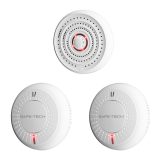
For example, at the time of writing, SAFE-TECH lists the following products:
- Mains-powered radio-interlinked smoke alarm with 10-year back-up battery.
- Mains-powered radio-interlinked smoke, heat and CO alarm with 10-year back-up battery.
- Mains-powered interlinked smoke and heat alarm bundle kits — available in multi-alarm configurations, with listed prices varying by kit.
These are product prices, not complete installation quotations. Professional installation and any additional electrical work may increase the total cost. Prices and availability can also change.
When comparing products, consider the power supply, backup power, interlinking method, compatibility, required detection types and installation costs. The cheapest alarm is not necessarily the most suitable choice for your home.
Frequently Asked Questions
Do you need hard wired smoke alarms in every room?
Not necessarily. The required number and locations depend on the property’s layout, the relevant regulations and any additional fire safety requirements. Follow the applicable guidance and the alarm manufacturer’s instructions rather than assuming every room needs a separate smoke alarm.
Are hard-wired smoke alarms better than battery alarms?
Neither option is universally better. Hard-wired alarms are appropriate for certain installations, while sealed long-life battery alarms can be suitable for others. The correct choice depends on the property’s requirements, the system design and how the alarms will be maintained.
Can wireless interlinked smoke alarms meet UK requirements?
They can in some circumstances. Scotland permits suitable radio-interlinked systems, and Northern Ireland’s private tenancy rules allow hard-wired or sealed-battery alarms, provided the relevant requirements are met. Wales has specific electrical-supply requirements for rented properties. Always check the rules that apply to your location and property type.
Do landlords need hard-wired smoke alarms?
It depends on where the property is located. In England, the general private rented sector smoke alarm regulations do not specify that every required alarm must be mains-powered. In Wales, each storey of a relevant rented home must have a smoke alarm connected to the electrical supply and linked to the other smoke alarms connected to that supply. Scotland and Northern Ireland have different requirements and allow suitable sealed-battery options in the circumstances described by their respective guidance.
Do hard-wired smoke alarms still need a backup battery?
Some mains-powered models include a backup battery or another standby power source, but the arrangement varies by product. Check the product specifications and the requirements for the intended installation. Do not assume every hard-wired alarm has the same backup capability.
How often should smoke alarms be tested?
Follow the manufacturer’s instructions for testing, maintenance and replacement. The Scottish Government recommends testing alarms regularly, and fire safety guidance commonly advises weekly testing. Replace alarms when required and never ignore a fault warning.
Final Thoughts: Do You Need Hard Wired Smoke Alarms?
So, do you need hard wired smoke alarms? Not in every UK home, but they are required or expected in certain situations, and the rules vary by location and property type.
Before buying new smoke alarms, check the applicable regulations, confirm whether your alarms need to be interlinked, and decide whether a mains-powered or sealed-battery system is appropriate.
If you are looking for a mains-powered option, explore the SAFE-TECH range of mains-powered fire alarms. Compare the product specifications carefully and seek professional installation where required.
Choosing the right system is about more than power supply. The priority is to install suitable alarms in the correct locations, ensure they work together where required, and maintain them so your home has an effective early warning of fire.