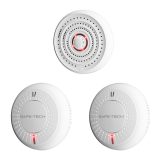
How Many Smoke Alarms Do I Need? | England Guide 2026

England Fire Alarm Guide (2026) — practical examples for flats, family homes and rented properties.
| Quick answer: If you are asking “how many smoke alarms do I need?”, start with at least one working smoke alarm on every level of your home. For stronger coverage, consider smoke alarms in hallways, landings and frequently used rooms, plus a heat alarm in the kitchen. The exact number depends on the layout, number of storeys and risks in the property. Rented homes, new dwellings and HMOs can have additional requirements. There is no simple “one alarm per bedroom” rule for a normal existing owner-occupied home in England. A two-bedroom flat, a two-storey house and a four-bedroom family home can all need different alarm layouts. The safest way to choose is to start with the property layout, then decide whether you want standalone, battery-interlinked or mains-powered interlinked protection. |
This article focuses specifically on alarm numbers and typical layouts. Product recommendations follow the same SAFE-TECH product routes used in our published England Fire Alarm Buying Guide 2026.
1. How Many Smoke Alarms Do I Need? Start With Every Level
Current Fire Kills guidance says to have at least one working smoke alarm on every level of your home and to test alarms at least monthly. It also advises that having more alarms in more places increases protection, and suggests considering smoke alarms in frequently used rooms, including bedrooms. A heat alarm can be used in the kitchen, where a smoke alarm may be more prone to nuisance alarms from normal cooking.
Official guidance: Fire Kills — Detection and smoke alarm guidance
Is one smoke alarm per floor enough?
One alarm per level is an important starting point, but it is not necessarily the best coverage for every property. Long hallways, several reception rooms, closed bedroom doors, converted lofts and larger floor areas can all affect how quickly smoke reaches an alarm and how clearly the warning can be heard.
For this reason, SAFE-TECH recommends thinking in terms of detection points rather than bedroom count alone: protect each level, consider escape routes and main living areas, use a heat alarm in the kitchen, and add carbon monoxide protection where required.
2. How Many Smoke Alarms Do I Need in a 2-Bed Flat?
For a compact one-level flat, at least one working smoke alarm may provide the basic starting point. For improved coverage in a typical two-bedroom flat with a lounge, central hallway and kitchen, a practical arrangement can be:
• 1 smoke alarm in the hallway or main circulation space.
• 1 additional smoke alarm in the lounge or main living room.
• 1 heat alarm in the kitchen.
• A suitable carbon monoxide alarm where a fixed combustion appliance requires CO protection.

Illustrative 2-bedroom flat example. The correct alarm configuration depends on the actual layout and applicable requirements.
Starter option: SAFE-TECH Standalone Smoke & Carbon Monoxide Alarms
Mid-range option: SAFE-TECH Battery Interlinked Fire Alarms
Premium option: SAFE-TECH Mains-Powered Interlinked Fire Alarms
3. How Many Smoke Alarms Do I Need in a 2-Storey House?
For a typical two-storey owner-occupied house, SAFE-TECH’s published England buying guide uses three smoke alarms and one heat alarm as a practical example, subject to the actual property layout. A common arrangement is:
• 1 smoke alarm in the ground-floor hall or circulation area.
• 1 smoke alarm on the first-floor landing.
• 1 smoke alarm in the main living room for additional early warning.
• 1 heat alarm in the kitchen.
• Add suitable CO protection where there is a relevant fixed combustion appliance.
In a multi-storey home, interlinked alarms are particularly useful because when one compatible alarm detects danger, linked alarms elsewhere in the home can also sound. This can improve the chance that occupants upstairs hear an alarm that starts downstairs, and vice versa.

Illustrative two-storey example. Use the property layout and current guidance to determine the final number and position of alarms.
Recommended battery-interlinked kit: 3 Smoke + 1 Heat Interlinked Alarm Kit
Premium mains-powered kit: Mains-Powered Interlinked Smoke + Heat Alarm Kit
4. How Many Smoke Alarms Do I Need in a 4-Bedroom House?
A four-bedroom house does not automatically need four smoke alarms. The number of bedrooms is only one part of the picture. Start by counting the storeys, hallways and landings, then consider the main living area, kitchen and any extra risk areas.
For example, a conventional four-bedroom, two-storey home may still begin with a three-smoke + one-heat arrangement: one smoke alarm in the ground-floor hall, one on the upstairs landing, one in the main living room and one heat alarm in the kitchen. Extra alarms may be sensible where the home has a converted loft, multiple reception rooms, a long or divided landing, an integral garage or other areas where detection or audibility could be reduced.
For larger homes, a custom interlinked system is usually a better buying approach than selecting a bundle purely by bedroom count.
Build a battery-interlinked system: Create My Own Battery Interlinked Bundle
Build a premium mains-powered system: Build Your Own Mains Interlink Bundle
5. What If My Home Has a Boiler, Open Fire or Wood Burner?
Smoke and heat alarms detect fire; carbon monoxide alarms detect carbon monoxide. They perform different jobs. In relevant rented properties in England, a carbon monoxide alarm is required in a room used as living accommodation that contains a fixed combustion appliance, excluding gas cookers. Owner-occupiers should also consider suitable CO protection where there is a combustion risk and follow current product and installation guidance.
If your home needs smoke, heat and CO protection, choose a kit that combines the required alarm types rather than treating a CO alarm as a replacement for smoke detection.
Battery-interlinked home kit: Interlinked Smoke + Heat + Carbon Monoxide Alarm Kit
Premium mains-powered fire alarm option: Mains-Powered Interlinked Fire Alarm + Multi-Sensor Bundle
Additional compatible CO option: SAFE-TECH Battery Radio-Interlinked Carbon Monoxide Alarm
6. How Many Smoke Alarms Are Required in a Rented Property?
For relevant rented properties in England, landlords must provide at least one smoke alarm on every storey where there is a room used wholly or partly as living accommodation. They must also provide a carbon monoxide alarm in any room used as living accommodation that contains a fixed combustion appliance, excluding gas cookers, and repair or replace prescribed alarms once informed and found to be faulty.
The regulations do not prescribe one specific alarm power type. SAFE-TECH’s published England buying guide recommends considering the Grade D1 mains-powered interlinked range for landlords seeking a robust, low-maintenance professional installation, subject to the property design and applicable requirements. This is a product recommendation, not a statement that every rented home is legally required to use Grade D1 alarms.
Recommended professional range: SAFE-TECH Grade D1 Mains-Powered Interlinked Fire Alarms
Official reference: GOV.UK — Smoke and Carbon Monoxide Alarm Regulations guidance
7. New Homes and HMOs: Do Not Rely on a Simple Alarm Count
New dwellinghouses and HMOs can require a more specific fire-alarm design than the examples used for an existing owner-occupied home. Current Approved Document B guidance says that, for Building Regulations purposes, new dwellinghouses should have smoke alarms designed and installed to at least Grade D2, Category LD3 in accordance with BS 5839-6.
HMOs require particular care. The appropriate Grade, Category and system design can vary according to the property, number of storeys, occupancy, licence conditions, local authority requirements and fire risk assessment. Some HMOs may use mains-powered Grade D systems, while larger or higher-risk properties may require Grade A systems. Do not order a domestic kit for an HMO solely from a generic bedroom or storey count.
Building Regulations reference: GOV.UK — Approved Document B fire safety FAQs
HMO reference: GOV.UK — HMO licence guidance
8. Standalone vs Battery Interlinked vs Mains-Powered Fire Alarm: Which Should I Choose?
Once you know how many detection points your home needs, the next question is how those alarms should work together. SAFE-TECH’s England range gives homeowners three clear buying routes.
| Alarm type | What it offers | Typical use |
| Standalone | Essential detection without an interlinked system. | Small owner-occupied homes and straightforward replacements. |
| Battery interlinked | Compatible alarms can sound together without a separate interlink cable. | Existing homes, family houses and retrofit projects. |
| Mains-powered interlinked | Grade D1 range with fixed 230V mains power, 10-year tamper-proof backup battery and built-in radio interlink. | Renovations, professional installations, landlords and suitable projects. |
Browse: Standalone Fire Alarms | Battery Interlinked Fire Alarms | Mains-Powered Interlinked Fire Alarms
Important: SAFE-TECH 230V mains-powered alarms must be installed by a qualified electrician.
9. Quick Guide: How Many Alarms for Different Homes?
| Property type | Practical starting point | Buying route |
| Small flat / apartment | At least one smoke alarm on the level; consider extra coverage based on layout. | Standalone or battery interlinked |
| Typical 2-storey house | Practical SAFE-TECH example: 3 smoke + 1 heat. | Battery interlinked or mains-powered interlinked |
| 4-bedroom / larger house | Count storeys, halls, landings and main living areas; add detection where needed. | Custom interlinked bundle |
| Home with boiler / open fire / wood burner | Add suitable CO protection where required. | Smoke + heat + CO arrangement |
| Rented property | At least one smoke alarm on each storey containing living accommodation; CO where regulations require. | Select alarms to meet landlord duties |
| HMO | No generic alarm count is appropriate. | Confirm Grade, Category, licence and fire risk assessment |
10. Frequently Asked Questions About Fire Alarms
How many smoke alarms do I need in my house?
Start with at least one working smoke alarm on every level. The final number should reflect your hallways, landings, living areas, bedrooms, property size and fire risks. A heat alarm can be used in the kitchen.
How many smoke alarms do I need in a 4-bedroom house?
There is no universal one-per-bedroom rule. A typical two-storey four-bedroom home may start with smoke alarms in the hall, landing and main living room plus a heat alarm in the kitchen, but larger or more complex layouts may need additional detection.
How many fire alarms do I need in a house?
For domestic properties, the answer depends on the type of detection and the layout. Start with smoke detection on every level, then consider additional smoke alarms, a kitchen heat alarm and CO protection where appropriate.
Should I have a smoke alarm in every room?
Not necessarily. Fire Kills recommends at least one on every level and says more alarms in more places increase protection. It suggests considering smoke alarms in frequently used rooms, including bedrooms.
Where should smoke alarms be installed?
Fire Kills advises fitting alarms on the ceiling, ideally in the middle of a room, and in halls and landings so they protect escape routes and can be heard throughout the home. Always follow the manufacturer’s instructions.
Do I need a smoke alarm in the kitchen?
A heat alarm is generally more suitable for a kitchen because normal cooking smoke or steam can trigger nuisance alarms. Follow the manufacturer’s positioning instructions.
Do smoke alarms need to be interlinked in England?
There is no blanket interlinking requirement for every existing owner-occupied home in England. Interlinked alarms can nevertheless provide improved whole-home warning. New homes, HMOs and other property types can have additional requirements.
Do rented properties need smoke alarms?
Yes. Relevant landlords must provide at least one smoke alarm on each storey containing living accommodation, plus carbon monoxide alarms where the regulations require them.
How often should smoke alarms be tested?
Current Fire Kills guidance says smoke alarms should be tested at least monthly. Always follow the manufacturer’s instructions for your specific alarm.
How long do smoke alarms last?
Alarm life varies by model. Fire Kills says replacing alarms every ten years is generally a good idea, although an alarm may need replacing sooner depending on its condition, activation history and manufacturer instructions.
Choose the Right Number — Then Choose the Right System
If you are deciding how many smoke alarms you need, begin with the layout of the home rather than the number of bedrooms. Make sure every level is covered, pay attention to hallways and landings, consider additional smoke alarms in main living or sleeping areas, use a heat alarm in the kitchen and add suitable CO protection where needed.
For a typical two-storey owner-occupied home, SAFE-TECH’s 3-smoke + 1-heat interlinked bundle is a practical starting point. Larger homes can build a custom battery-interlinked or mains-powered system, while homes with a boiler, open fire or wood burner can add suitable CO protection. Landlords and HMO owners should confirm the requirements that apply to their property before ordering.
SHOP FIRE ALARMS & BUILD YOUR SYSTEM
Browse SAFE-TECH Fire Alarm Kits
Build Your Own Battery Interlink Bundle
Build Your Own Mains Interlink Bundle
References
Fire Kills — Detection: smoke alarm coverage, positioning and testing
GOV.UK — Smoke and Carbon Monoxide Alarm Regulations guidance for landlords and tenants