How to Install a Battery Smoke Alarm Safely

Installing a battery smoke alarm is one of the simplest ways to improve fire safety in your home. However, choosing the right location, securing the alarm correctly and testing it after installation are all essential steps. A smoke alarm that is poorly positioned, incorrectly fitted or not working properly may not provide the early warning you need in a fire.
If you are wondering how to install a battery smoke alarm safely, this guide explains everything you need to know, from choosing the best position to mounting the alarm and checking that it works.
Whether you are fitting a new smoke detector, replacing an older unit or adding extra alarms to your property, following the manufacturer’s instructions will help you install it correctly.
In this guide, we cover where to install a battery smoke alarm, how to fit one to a ceiling, whether you can install it yourself, common installation mistakes and what to do after fitting your alarm.
1. Choose the Right Battery Smoke Alarm
Before installing a battery smoke alarm, make sure you have selected a model suitable for your property and intended location.
Battery smoke alarms are available with replaceable batteries or sealed long-life batteries. Both types need to be tested and maintained according to the manufacturer’s instructions.
Replaceable-battery smoke alarms
These alarms allow you to replace the battery when necessary. Check which battery type the manufacturer specifies, as not every smoke alarm uses the same battery.
You will also need to replace the battery when the alarm indicates that it is running low, following the instructions supplied with the device.
Sealed-battery smoke alarms
A sealed-battery smoke alarm contains a battery that is not intended for routine replacement by the user. Some models are designed with a long-life battery and a specified sensor lifespan.
These alarms can reduce the need for regular battery changes. However, you must still test the alarm and replace the complete unit when required by the manufacturer.
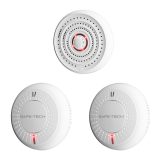
For example, SAFE-TECH offers standalone battery smoke alarms, including models with replaceable and tamper-proof batteries. Check the individual product page for its installation instructions, features and service life.
When choosing a smoke alarm, look for a model intended for domestic use that meets the relevant product requirements. In the UK, domestic smoke alarms are commonly assessed against BS EN 14604. Always check the documentation for the exact product you intend to install.
2. Where Should You Install a Battery Smoke Alarm?
Choosing the correct location is one of the most important parts of installing a battery smoke alarm.
Smoke rises, so ceiling mounting is generally recommended. The alarm should also be positioned where its warning can be heard throughout the home, particularly in sleeping areas.
Recommended locations
For many homes, useful locations include:
- Hallways: Place an appropriate smoke alarm in circulation areas where it can provide an early warning.
- Landings: In a multi-storey home, alarms on upper landings can help alert people on different floors.
- Living areas: Consider additional protection in rooms where fires could start, following the relevant guidance and product instructions.
- Bedrooms or sleeping areas: Additional alarms may be appropriate depending on the layout of your property and the level of protection required.
As a general starting point, UK fire safety guidance recommends having at least one working smoke alarm on each level of a home. The number and position of alarms you need will depend on your property, the applicable requirements and your fire safety arrangements.
How far should a smoke alarm be from a wall?
Smoke alarms are generally best installed on the ceiling, near the centre of the room or circulation area. Many UK fire safety services advise keeping the alarm at least 30 cm away from walls and light fittings.
This is a general positioning guide rather than a universal measurement for every alarm. Always follow the installation instructions for your specific model, including any requirements concerning beams, sloping ceilings or other obstructions.
For further advice, consult the official GOV.UK fire safety guidance.
Where should you avoid installing a smoke alarm?
Avoid placing a standard smoke alarm in locations where normal household activity may cause repeated false alarms or where environmental conditions may affect its operation.
These may include:
- Directly beside a kitchen, where cooking fumes can trigger the alarm.
- Bathrooms, where steam may cause unwanted activations.
- Close to doors, windows or ventilation outlets where air movement could affect smoke reaching the sensor.
- Areas exposed to excessive moisture, dust or temperatures outside the manufacturer’s specified range.
- Locations where the alarm cannot be heard clearly.
A suitable heat alarm is often recommended for a kitchen rather than a standard smoke alarm. However, a heat alarm does not replace smoke alarms required elsewhere in the home.
3. What Tools Do You Need to Install a Battery Smoke Alarm?
Most battery smoke alarms are designed for relatively straightforward installation. The exact equipment required depends on the mounting system supplied with the product.
Before starting, check the installation manual and prepare the following items if required:
- The battery smoke alarm and its mounting plate.
- The screws and wall plugs supplied with the alarm.
- A pencil for marking fixing positions.
- A suitable drill and screwdriver, if screw fixing is required.
- A stable step ladder or platform.
- A suitable tool for checking for hidden cables and pipes before drilling.
Some alarms use a mounting plate that attaches with screws. Do not assume that adhesive pads, double-sided tape or glue are suitable alternatives. Incorrect adhesive fixing may allow the alarm to fall or interfere with its operation.
Before drilling, check the area for hidden electrical cables and pipes. If you cannot establish that the drilling location is safe, choose another suitable position or ask a competent person for help.
If you are not confident working at height or using the necessary tools, consider asking a professional to install the alarm.
4. How to Install a Battery Smoke Alarm Step by Step
The following steps provide a general guide to installing a battery smoke alarm. Your product may use a different mounting mechanism, so the manufacturer’s instructions must take priority.
Step 1: Read the installation instructions
Before fitting the alarm, read the user manual carefully.
Check the recommended installation location, mounting requirements, battery arrangements and test procedure. If the alarm is part of an interlinked system, confirm how it should be paired with compatible units.
Do not assume that all battery smoke alarms install in exactly the same way.
Step 2: Mark the correct position
Choose a suitable ceiling location based on the manufacturer’s guidance and your home’s layout.
Avoid walls, light fittings and other obstructions by the distances specified in the instructions. Make sure the alarm will not be affected by unsuitable environmental conditions.
Mark the fixing positions using the supplied mounting plate as a guide.
Step 3: Check for hidden cables and pipes
Before drilling, check the fixing area for concealed electrical wiring and plumbing.
This is particularly important near light fittings, switches, pipe routes and other electrical installations. If you suspect that cables or pipes run behind the surface, do not drill until you have established a safe alternative.
Step 4: Secure the mounting plate
If the alarm uses a screw-fixed mounting plate, use the supplied fixings or those specified by the manufacturer.
Make sure the plate is securely attached to the ceiling and does not wobble. Do not overtighten screws if doing so could damage the mounting plate or ceiling surface.
If the alarm uses a different mounting system, follow the supplied instructions rather than adapting it with unapproved fixings.
Step 5: Fit the battery or activate the sealed battery
For a model with a replaceable battery, insert the specified battery in the correct orientation. Make sure the contacts are properly aligned and the battery compartment is closed securely.
For a sealed-battery smoke alarm, follow the manufacturer’s activation instructions. Some models require a switch, pull tab or other activation procedure before installation.
Do not attempt to open a sealed-battery alarm or remove its built-in battery.
Step 6: Attach the smoke alarm
Fit the alarm to its mounting plate as instructed. Depending on the model, this may involve aligning the unit and turning it until it locks into place.
Check that the alarm is secure and correctly seated. An alarm that has not engaged with its mounting plate may fall or fail to operate as intended.
Step 7: Test the alarm
After installation, use the test button according to the manufacturer’s instructions.
The alarm should produce the expected test sound or indication. If it does not, check the installation manual for the correct activation and testing procedure.
For a battery-powered alarm, check the battery orientation or activation steps where applicable. If the alarm still fails to test, do not assume it is protecting your home. Contact the manufacturer or replace the unit if instructed.
If you are installing interlinked alarms, follow the manufacturer’s procedure to check that all compatible units communicate and sound as intended.
5. Can You Install a Battery Smoke Alarm Yourself?
In many ordinary domestic situations, a battery-powered smoke alarm can be installed by the homeowner by following the manufacturer’s instructions.
Unlike a mains-powered smoke alarm, a standard battery-only model does not usually require connection to fixed electrical wiring.
However, there are important exceptions. Landlords, houses in multiple occupation (HMOs) and other regulated premises may have specific requirements for alarm systems, installation, maintenance or the competence of the person carrying out the work.
If you live in rented accommodation, check your tenancy arrangements and speak to your landlord or property manager before making changes to an existing alarm system. Do not remove or disable an existing alarm without ensuring suitable protection remains in place.
For mains-powered smoke alarms, fixed electrical installation work should be undertaken by a suitably qualified electrician.
The rules also differ between England, Scotland, Wales and Northern Ireland. For example, Scotland has specific home alarm requirements that include interlinked smoke and heat alarms. A single standalone battery smoke alarm may therefore not be sufficient to meet the requirements for a particular Scottish property.
Always check the current rules that apply to your home rather than assuming that the same requirements apply throughout the UK.
6. What Should You Do After Installing a Smoke Alarm?
Correct installation is only the first step. You must also ensure the alarm remains operational.
Test the alarm regularly
Use the test button at the interval specified by the manufacturer and follow local fire safety advice. Some UK fire and rescue services recommend weekly testing.
A successful test provides an important check of the alarm’s operation, but you should not ignore fault warnings or an expired service life.
You can read our related guide: How to Test a Smoke Alarm UK.
Keep the alarm clean
Dust and debris can affect a smoke alarm. Clean it according to the manufacturer’s instructions, using only the recommended method.
Do not spray cleaning products directly into the alarm or dismantle the unit unless the manufacturer specifically instructs you to do so.
Replace batteries or the complete alarm when required
For alarms with replaceable batteries, follow the specified replacement procedure and respond promptly to low-battery warnings.
For sealed-battery alarms, follow the end-of-life instructions. If the battery or sensor cannot be replaced separately, the complete alarm may need replacing.
For more information, see our guide on how to change a smoke alarm battery.
Make sure everyone can hear the alarm
Consider whether the alarm can be heard when bedroom doors are closed and when people are asleep. If your home has multiple floors or areas where an alarm might not be heard clearly, consider whether additional or interlinked alarms are appropriate.
SAFE-TECH offers battery-powered radio-interlinked smoke alarms for properties where compatible alarms that communicate with one another are required. Check the product documentation to confirm system compatibility.
7. Common Mistakes When Installing a Battery Smoke Alarm
Even a good smoke alarm can be less effective if it is installed incorrectly. Avoid these common mistakes:
Installing it in the wrong place. A position too close to cooking fumes, steam or ventilation outlets may cause nuisance alarms or affect detection. Follow the manufacturer’s positioning guidance.
Using unapproved adhesive fixings. Do not glue an alarm to the ceiling unless the manufacturer explicitly approves the method for that model.
Forgetting to activate or test the alarm. A newly fitted alarm should be tested before you rely on it.
Choosing the wrong battery. Always use the battery type specified by the manufacturer. Never force an incompatible battery into the compartment.
Ignoring the replacement date. An alarm can reach the end of its service life even if it still produces a sound when tested.
Assuming one alarm is enough for every home. A property’s size, layout, number of floors and applicable rules all affect the level of protection required.
Removing the alarm after a false alarm. If nuisance alarms occur repeatedly, investigate the cause safely and review the installation location. Never leave the home without appropriate working fire detection.
Frequently Asked Questions
How do you install a battery smoke alarm on the ceiling?
Choose a suitable position, check for hidden cables and pipes, mark the fixing points, secure the mounting plate using the approved fixings, attach the alarm and test it. Always follow the instructions for your exact model.
Can I install a battery smoke alarm without drilling?
Some products may offer an approved alternative mounting method, but not all do. Check the manufacturer’s instructions before using adhesive or other non-standard fixings. If the supplied alarm is designed for screw fixing, use the specified method.
Should a battery smoke alarm be fitted to the ceiling or wall?
Ceiling mounting is generally recommended for domestic smoke alarms. If wall mounting is permitted for your model, follow the specified height and positioning requirements. Do not assume that every alarm can be mounted on a wall.
How long does it take to install a battery smoke alarm?
A straightforward installation may take only a short time, but the duration depends on the mounting system, ceiling material and preparation required. Allow enough time to choose a suitable location, check for hidden services, secure the alarm properly and test it.
Do I need an electrician to install a battery smoke alarm?
A standard battery-powered alarm can usually be fitted by the user in an ordinary domestic setting. Specific property rules or system requirements may differ. Mains-powered alarms that connect to fixed wiring should be installed by a suitably qualified electrician.
How often should I test my newly installed smoke alarm?
Test it after installation and then follow the manufacturer’s instructions and local fire safety guidance. Some UK fire and rescue services recommend testing weekly. Also check the alarm’s service life and respond promptly to fault warnings.
Conclusion: Install Your Battery Smoke Alarm Correctly
Knowing how to install a battery smoke alarm safely can help you improve fire protection at home. The most important steps are choosing a suitable alarm, selecting the correct position, securing the mounting plate properly and testing the unit after installation.
Remember that the installation instructions for your specific model should always take priority over general advice. Your home’s layout and the rules that apply to your property may also affect the number and type of alarms you need.
If you are choosing a new alarm, explore the SAFE-TECH standalone smoke alarm range or compare battery-powered interlinked smoke alarms.
Choose a suitable product, install it correctly and keep it tested and maintained. A properly installed and working smoke alarm is an important part of your household fire safety plan.